Fraud scores get argued with. Evidence gets admitted.
WardTrace turns insurance-fraud detection into proof built for audits and courtroom scrutiny. We catch contradictions before the money leaves. We attach durable evidence to the honest claims too.
- 43% of Medicare RPM enrollees were missing at least one required component. HHS OIG, 2024
- 521,997 synthetic claims in our test corpus, byte-reproducible
- 7 running inventions tested code today; 23 inventions mapped across the system
Every fraud score has the same three flaws.
It arrives too late.
The score often appears after the claim is paid. The money is already gone, so recovery becomes a slow clawback fight.
It cannot explain itself.
A mystery model produces a number, not a specific “this record contradicts that record.” A lawyer can argue with a hunch.
It leaves nothing behind.
There is no durable packet an auditor, court, or opposing expert can independently check again.
A fraud score is a smoke alarm that beeps but cannot prove there was a fire.
A WardTrace certificate is the security-camera footage, with a public timestamp attached.
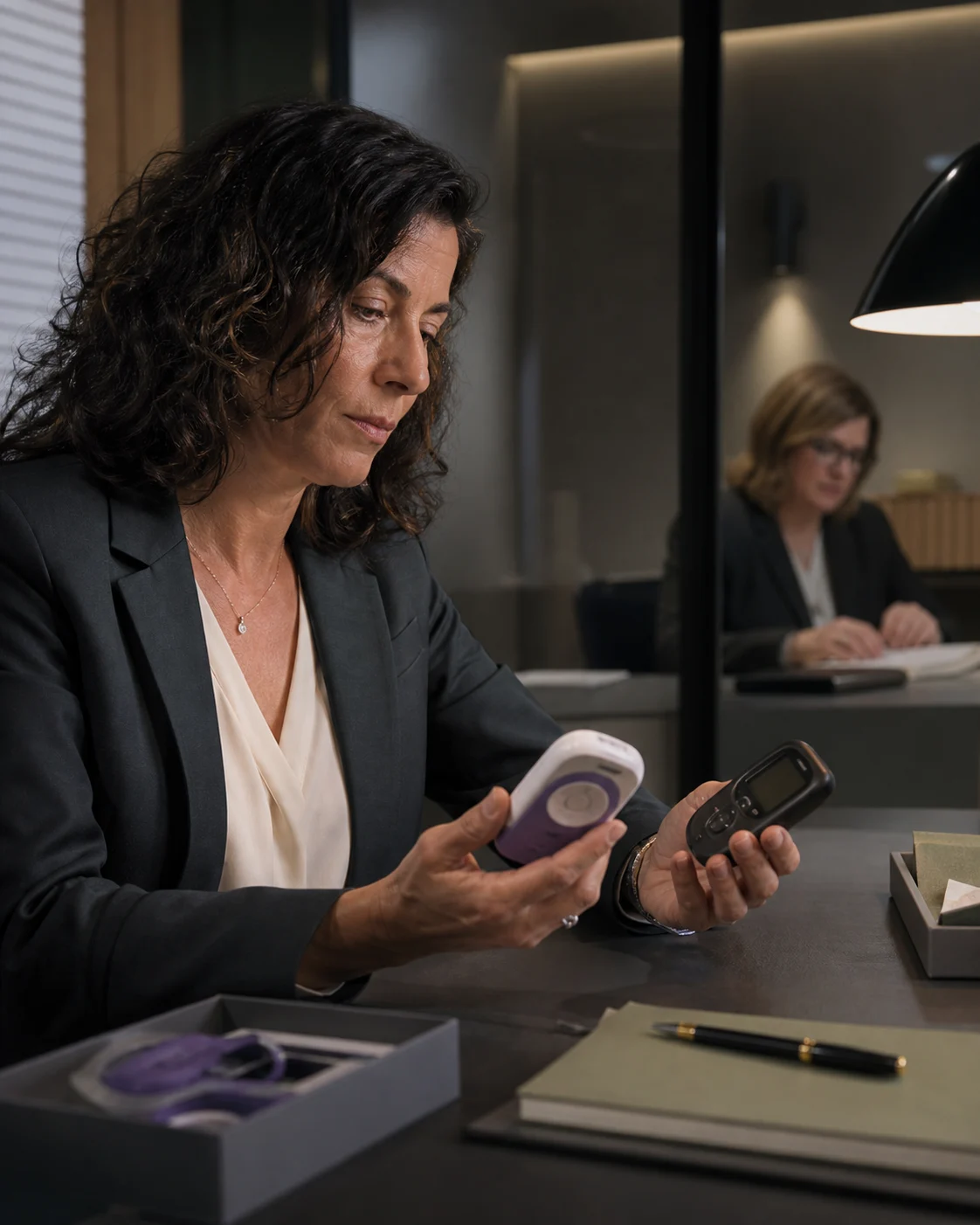
Remote Patient Monitoring is the wedge.
RPM vendors already hold the orders, consent records, device serials, timestamps, and reading streams needed to prove what happened.
The problem is already public.
Federal auditors found that 43% of Medicare RPM enrollees were missing at least one required component. That is a completeness finding, not a WardTrace estimate.
Prove the honest majority are clean.
Auditors can sample a small set of claims and extrapolate the error rate across an entire book. The expensive problem is not only bad claims. It is healthy claims that cannot prove they are healthy.
WardTrace attaches a certification packet to the clean claims too, so an honest vendor can answer with evidence instead of a promise.
Prevent. Detect. Prove.
Prevent
Consent is sealed at the point of care, so the record exists before any dispute does. Patent filed.
Detect
28 deterministic rules look for typed contradictions between records. Not patterns in a black box.
Prove
Every finding ships in a hash-chained bundle with dual public timestamps. Change one byte and the chain breaks.
One claim, five checks. Watch it happen.
A synthetic RPM claim goes through the engine, step by step. Two checks fail. No score is produced. Evidence is.
The claim
CPT 99454, March. Five things must be true for this bill to be clean.
SYNTHETIC CASE
The checks
- PASS Order
- PASS Consent
- FAIL Device serial
- FAIL Reading days
- PASS Physician review
The verdict
Two typed contradictions, each citing its rule and records. One tamper-evident bundle. No fraud score anywhere.
The score business versus the proof business.
| Question | Traditional fraud tools | WardTrace |
|---|---|---|
| When? | After payment | Before billing |
| How? | Black-box suspicion score | Fixed, readable rules |
| What comes out? | A number | A sealed, re-verifiable certificate |
| Who decides? | Opaque model | Human review with cited evidence |
| How is it priced? | Often tied to recoveries | Flat fee per device |
Mapped broadly. Built where it matters first.
The engine runs on a fully synthetic corpus today. It is not yet live on a payer’s production data. Field performance requires a calibration pilot, and we say that plainly.
We publish our low numbers too.
Five of our 27 measured rules, including two that are not ready yet. A number you can check beats a wall of perfect ones.
| Rule | Precision measured on synthetic ground truth | Labeled cases | True positives | False positives |
|---|---|---|---|---|
| Rpm coherence | 1.00 synthetic ground truth | 400 | 80 | 0 |
| Deceased patient | 1.00 synthetic ground truth | 315 | 285 | 0 |
| Missing pathology | 0.98 synthetic ground truth | 312 | 103 | 2 |
| Missing anesthesia | 0.48 synthetic ground truth | 3,646 | 1,219 | 1,303 |
| Missing facility | 0.33 synthetic ground truth | 1,352 | 670 | 1,360 |
Field performance is different from synthetic performance. Before any production use we run a calibration pilot on the customer's own data and report those numbers instead.
Six entries, one chain: the Claim Passport.
Each entry is hashed into the next. Change one byte anywhere and the chain breaks visibly.
- 1. Claim. The claim under examination, exactly as billed.
- 2. Findings. Each typed contradiction, citing rule and record.
- 3. Methodology. Rules version, code commit, validation status.
- 4. Gap list. What this bundle does not verify. Stated, not hidden.
- 5. Reproducibility kit. Everything an opposing expert needs to re-run it.
- 6. Anchor. Public timestamps: OpenTimestamps and RFC-3161.
$1 to $3 per device, per month. Flat.
No per-bundle fees. No percentage of recoveries. That structure is deliberate: our revenue must never grow when accusations grow.
Fake documentation is getting cheaper. Independent proof matters more.
AI changed the cost.
Cloned notes, synthetic records, and fabricated media are now cheap to produce.
Audits are already here.
The federal RPM completeness finding is public. Vendors need defensibility now.
The category is open.
Everyone sells the score. WardTrace sells the certificate.
Straight answers, on the record.
Is this AI?
No. These are deterministic rules with measured precision. Every finding cites the rule and the record that produced it. The result is reproducible byte for byte.
What is your accuracy on real data?
Precision is measured on labeled synthetic data today. On your data we run a calibration pilot first and report your numbers. We will not quote synthetic precision as field performance.
Do you deny claims?
Never automatically. A suspicious claim routes to human review. The system escalates. It does not auto-deny.
Is this admissible in court?
Courts decide admissibility case by case, so we do not promise it. The bundle is designed for that scrutiny. It documents one specific contradiction, names its own methodology and rules version, lists what it does not verify, and ships a reproducibility kit an opposing expert can re-run.
What does it not verify?
Medical necessity and the clinical accuracy of readings. The bundle says so itself, in its gap list. That honesty is part of the design.
What data was this tested on?
A fully synthetic corpus of 521,997 claims. It is byte-reproducible from a seeded generator and contains zero PHI. No real patient or provider data is anywhere in the system.
See it on your own screen.
One synthetic claim. Five checks. Two contradictions. A sealed certificate you can re-verify yourself.